
Core idea
RAG the index
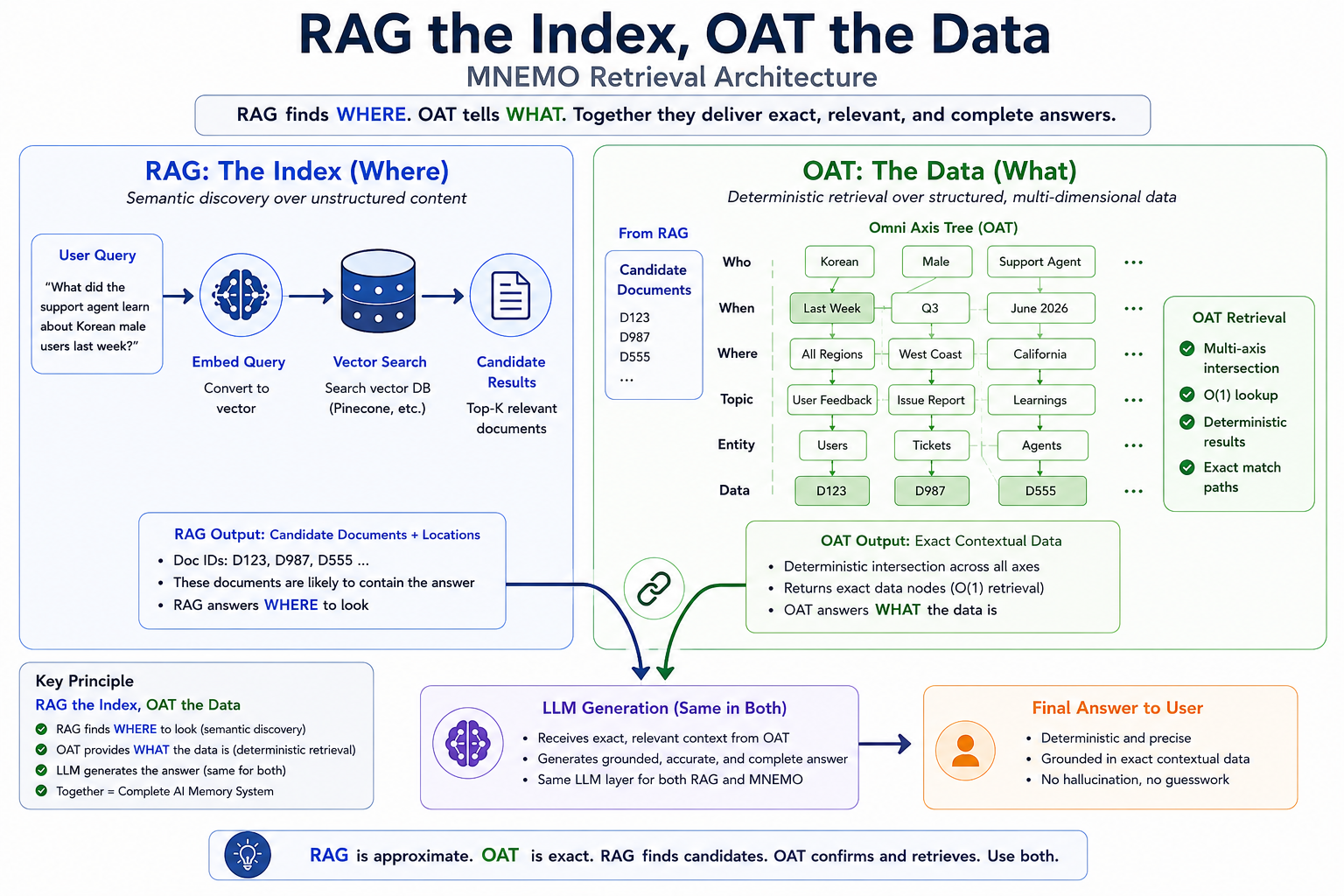
Think of this as a smart search helper reading a map. The LLM does not rummage through every memory record. Instead, it looks at a short list of human-readable Memory Paths and figures out which one matches the question best.
Architecture
In simple terms: RAG helps the model choose the right descriptive index path, while OAT retrieves the actual data directly and deterministically.

Core idea
Think of this as a smart search helper reading a map. The LLM does not rummage through every memory record. Instead, it looks at a short list of human-readable Memory Paths and figures out which one matches the question best.
Core idea
Once the path is chosen, Mnemo uses the Omni Axis Tree to fetch the actual stored data directly. No fuzzy guessing, no approximate nearest-neighbor guesswork, and no extra semantic search over the content itself.
In the diagram, this is the lower half of the flow: the exact retrieval layer that returns the data after the index path has already been selected.
Layman version
If a traditional RAG system is a giant pile of notes with a very smart highlighter, Mnemo is a labeled filing cabinet. The LLM helps pick the right label; OAT opens the exact drawer and returns the exact contents.
That separation matters because it keeps the model’s “reasoning” where it belongs — choosing the route — while the retrieval layer stays deterministic and fast.
Why this is different
One-sentence summary
RAG helps Mnemo pick the route; OAT delivers the answer.That is the practical meaning of “RAG the index, OAT the data” — the index is where AI helps, and the data is where Mnemo stays exact.